Yes i have read about Jesus being Lucifer (which is Venus...astrolatry aka astro-theology)
For those unfamiliar with astrolatry...
Others interpret it differently in that Jesus and Lucifer are two different things, brothers even perhaps, representing dualism (good vs bad).
Of course the elite through religion teach us to be 'good' not bad, i suppose giving
a monopoly on being Luciferians.
It seems that many of these stories repeat themselves in a similar fashion in other religions going back (comparative mythology)
A luciferian i suppose is just someone who does whatever they want, a primordial creature. The elite/rulers perhaps.
Luciferianism is centered around Lucifer, the bringer of light (enlightenment).
Luciferian Principles
*The Luciferian is a superior illuminated being, and stands above idol worshipers.
*The Luciferians is proud of being all that is.
*The Luciferian is free to do as he wishes while accepting the consequences.
*The Luciferian is a person who strives for wealth, and lives in prosperity.
*The Luciferian accepts his carnal primordial nature as it is, and glorifies it.
*The Luciferian is merciful on those who have proven themselves worthy to him.
*The Luciferian is cruel and wrathful to those who have proven themselves worthy.
*The Luciferian imagines and theorizes, but is firmly grounded in reality.
*The Luciferian respects Mind, Body and Spirit.
*The Luciferian does not convert; Luciferianism is only for the elite, unlike Christianity where you may convert every fool that you come across.
*The Luciferian loves the earth and the sun, the stars and nature.
*The Luciferian respects people of abrahamic faiths, but not their ignorance.
*The Luciferian puts reason, the self and common sense squarely above god.
*The Luciferian has no fear, be that of hell fire or thunder bolt.
*The Luciferian whole heartedly accepts science and human ingenuity, as the most holy of principles.
*The Luciferian has but one mortal enemy, ignorance.
*The Luciferian exalts the throne of man.
*The Luciferian is held back by one person only, the self.
*The Luciferian has a sun burning inside of him, thus he may shine brighter than others.
*The Luciferian has a free heart, clean soul and a mind of purity.
*The Luciferian is perfect; perfection is a constant state of improvement.
*The Luciferian accepts spirituality, not as "spiritual pipe dreams" or "nonsensical hocus pocus", but rather as a science waiting to be discovered by the pure of mind.
*The Luciferian is might incarnate, a god in the flesh, the highest expression of life in this world.
*The most beautiful thing in Terra are the men and women who walk upon her.
*The ugliest thing in Terra is stratified religion and dead idols.
*Keep your words of wisdom in the shadows; the light is not for those who are without. Lest you regret it sorely.
Source(s):
Religious studies major
Ex LaVeyan Satanist
Pantheistic Luciferian
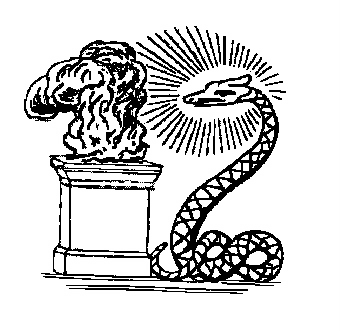
The serpent is also associated with duality, as well as death and re-birth, cycle of life etc..a long piece
about the serpent and religion... (it has a religious spin
The image of the serpent was tremendously significant in the ancient world. Societies and scriptures of the Near East simultaneously attributed two highly symbolic roles to serpents. One role connected serpents to the heavens by having them represent deity, creative powers, and healing. The other linked them with the underworld and associated them with evil, harm, and destructive influences. We who live in modern times have no difficulty appreciating this double symbol because, in fact, this duality persists in our own day. The symbol of the healing serpent appears on the physician's caduceus, while a person of disreputable actions—especially treachery—is sometimes referred to as "a snake."
A careful reading of Israel's sacred writings reveals that the same duality regarding serpent symbolism that existed among various peoples of the ancient Near East was also an integral part of the religious landscape of Jehovah's covenant people. Texts from both the Bible and Book of Mormon identify and allow us to attach proper name-titles to the two specific beings who are represented by the dual image of the serpent: Christ and Satan. By surveying nonbiblical Mediterranean and Mesopotamian cultural evidence as well as scripture, I hope to do three things: first, demonstrate the dual nature of serpent symbolism; second, examine the proposition that the ancient serpent myths of the Fertile Crescent and Mediterranean-based cultures are echoes of divine truth—namely, that from the beginning the true Messiah was legitimately represented by the image of the serpent, but that the symbol was usurped and perverted by the quintessential false messiah, Satan; and, third, explore whether or not the Book of Mormon fits the biblical and Near Eastern cultural environment regarding the dual nature of serpent symbolism.
Egyptian Evidence
The serpent as a dual, polar symbol emerged in the cradle of civilization during the earliest periods of history. Serpent symbolism among the ancient Egyptians demonstrates the most glaring contrasts between worship on the one hand and abhorrence on the other.
In Egypt the snake was a chthonic animal (a creature representing any one of a number of gods of the earth and underworld) and the embodiment of life-giving powers.[1] Attributing life-giving powers to snakes may have arisen in part from observing snakes shedding their skins, continually exposing a "new body" in the process. Thus, one of the forms of the god Atum, believed to be a primeval creator deity, was the snake or serpent that continued to live season after season. In a fascinating dialogue with Osiris, the Egyptian god of the netherworld and of final judgment,[2] Atum predicts the destruction of the world he created and his own reversion back to the form of a serpent or snake.[3] As Henri Frankfort says, "The primeval snake . . . survives when everything else is destroyed at the end of time."[4] Thus the serpent was strongly and continually associated with creation and eternal existence in the ancient Egyptian ethos. The Egyptians portrayed life itself by the image of the rearing serpent, and a serpent biting its tail was a common Egyptian emblem for "eternity."
Another primeval deity mentioned in the Pyramid Texts is Amun, one of whose two primary representations was that of the snake named Kematef (meaning "he who has completed his time").[5] After the Eleventh Dynasty (the Egyptian Middle Kingdom), Amun appeared as the god of the capital of Thebes and eventually merged with the sun god to be become known as Amun-Re, the supreme state god in the New Kingdom (c. 1550–1090 B.C.). At Karnak it was believed that Amun-Re and his divine consort, the goddess Mut, gave birth to a son named Khonsu. Mut is also symbolized as a snake and is called "Mut the resplendent serpent."[6] Thus the divine triad or family, the preeminent unit of social organization among the gods and humans according to the Egyptian worldview, was linked to the image of the serpent.
The close ties between birth, the goodness of the gods, rebirth, and the image of the serpent infused Egypt during all of her early historical periods down to the end of the New Kingdom. When corn was harvested and grapes pressed into wine, an offering was made to the harvest goddess, Thermuthis, who was depicted as either a snake or a woman with a serpent's head.[7] Geb, the god of the earth and "the father of the gods," is referred to as "the father of snakes" that emerge from the earth.[8] It is also significant, given Egyptian obsession with the quest for eternal life, that the snake "became a symbol of survival after death" (even resurrection) among the ancient Egyptians.[9] In the Egyptian Book of the Dead (sometimes referred to by its more precise title, The Book of Going Forth by Day), chapter 87, we are told that transformation into a serpent upon death gives new life to the deceased person.[10]
Veneration of serpents or snakes in predynastic Egypt and during the Old Kingdom coalesced around the most important serpent-goddess of Lower Egypt: Wadjet. Wadjet (meaning "green one") was the general Egyptian term for cobra, and in that form she became the symbol of royalty and unification. In fact, the cobra, or uraeus, became a generic Egyptian ideograph for the concept of immortality. Thus the pharaoh was described as "the living years of the uraeus."[11] Wadjet was attached to the royal crown as protectress of the king or pharaoh and in the end became the "eye of Re." As the "green one," the serpent Wadjet embodied the forces of growth and health. (Significantly, green was the color that symbolized resurrection in ancient Egypt.)[12]
In opposition to all that was good in ancient Egypt, the most preeminent of all the demons, evil gods, or evil powers was Apophis, who was represented by a snake. Apophis was "the serpent of darkness," the supreme opponent of the great sun god Re.[13] The Egyptian Book of the Dead fairly crawls with other serpent demons as well, sometimes winged or rearing up, occasionally even standing on legs and spitting fire. And yet the serpent demons are not more powerful or overpowering than those serpent deities in charge of the forces of good. For example, counterbalancing Apophis is the snake Mehen ("the coiled one"), who was the helpful attendant of the sun god Re. Mehen assisted Re on his journey through the realm of night so that he would reemerge unharmed morning after morning, day by day.[14] Thus the plans of a supreme spiritual adversary, represented by a serpent, were foiled by the powers of good, also represented by a serpent.
The negative aspects of serpent symbolism would have been particularly keen in the minds of Egyptian royalty as they thought about the afterlife. In fact, the dangers that had to be overcome after death during one's journey through the netherworld in order to gain eternal life were so great that discussion of these matters occupies a significant place in the funerary papyri of ancient Egypt. Even certain Pyramid Texts manifest this preoccupation, one of which indicates that the dead king (pharaoh) gains eternity by winning the "snake game."[15] Though little else is known about this element of the salvific process in ancient Egypt, one wonders if this contest was not symbolic of having to pass some kind of postmortal test or final judgment in which the deceased would be required to demonstrate his knowledge of special information gained through his mortal experiences. Perhaps. However, we can assert that, given such overwhelming evidence from texts and inscriptions, the serpent stood both for supreme goodness as well as ultimate evil among the ancient Egyptians and that serpent imagery was incontrovertibly associated with the afterlife, resurrection, and eternity.
Mesopotamian Evidence
Ancient Mesopotamian culture (indigenous to the area approximately encompassing modern Iraq) displays a dualism associated with serpent symbolism similar to that found in Egypt. The Sumerian god of spring vegetation, Tammuz, was linked to the image of the snake. Both he and his mother bore the title "mother-great-serpent of Heaven," that is, the serpent deity who emanated from the heaven god Anu.[16] The snake was also the sacred symbol of the god Ningizzida, who was called in Sumerian mythology "the companion of Tammuz."[17] He was the guardian at the door of heaven who had the power to bestow fertility, "who protected the living by his magic spells, and could ward off death and heal disease for the benefit of those who worshiped him devoutly."[18] The image of Ningizzida as a horned serpent on the seals of scrolls from ancient Mesopotamia seems to have been a sign of his divine power.[19]
As with the god Ningizzida, the Mesopotamian corn goddess, Nidaba, was shown in representations with serpents (springing from her shoulders).[20] In the Sumerian and Babylonian worldviews the serpent was symbolic of the regenerative and healing properties of certain elements and produce of the earth. Therefore, the Sumerians and Babylonians transformed these aspects of nature into special serpent deities as did other Semitic and Mediterranean cultures.[21]
The image of the serpent deity in ancient Mesopotamia spanned several time periods as well as cultures. The greatest sovereign the Sumerians ever produced, King Gudea of the city-state Lagash, placed a representation of a serpent deity at the entrance of one of his temples around 2050 B.C., presumably to act as a guardian of the sacred edifice where life is renewed. Fourteen hundred years later, King Nebuchadnezzar II, ruler of the Neo-Babylonian empire (605–562 B.C.), dedicated the monumental Ishtar Gate of Babylon to the god Marduk with the following inscription:
(Nebuchadnezzar, King of Babylon, son of) Nabopolassar (King of Babylon am I). The gate of Nana (Ishtar . . . I built) with (blue) enamelled bricks . . . for Marduk my lord. Lusty bulls of bronze and mighty figures of serpents I placed at their thresholds . . . Marduk, exalted lord . . . eternal life . . . give as a gift.[22]
Regarding the joining of the bull and serpent images, Karen Joines has shown that it also was found throughout the ancient Near East:
The cultic association of the bull with the serpent emphasizes the fertility aspect of the serpent. . . . The serpent-bull symbolism is widespread. Egypt, Mesopotamia, and Assyria have influenced the Canaanites at this point, and Palestine again becomes part of the larger Near East in its cultic symbolism.[23]
Not all Mesopotamian serpent images represented something beneficent. The oldest mythologies of ancient Mesopotamia have a familiar ring to them because they often parallel episodes found in the Old Testament and because their themes reflect the primeval struggle between two opposing powers. The story of the fall of man and the first family's expulsion from the garden (Genesis 3) presents details and undertones also found in the Sumerian tale of Enki and Ninhursag, the Adapa story, and the Gilgamesh epic.
In the Gilgamesh epic, Utnapishtim and his wife, who have become like the gods, present some hope by which Gilgamesh may also obtain everlasting life. Beyond the Waters of Death there exists a magic, life-giving plant that renews a person's youth. Gilgamesh gathers it, but an evil snake snatches this plant away, ending the hero's hope of eternal life. That the snake benefits from possession of the plant and lives on is evidenced by the fact that it sloughs off its old skin and enjoys a rejuvenation. Gilgamesh sits down and weeps over his own loss and the fact that he has played into the hands of the malevolent serpent.[24]
Thus the serpent in this epic fills a similar role as the serpent in Genesis, preventing the renewal of life by controlling or manipulating certain special flora to its advantage. Later Persian tradition also tells of a special plant that bestowed immortality. But Ahriman, the evil adversary of the one true "Wise Lord" (Ahura Mazda), created a serpent to destroy the miracle-working plant.[25]
The most troublesome of all serpents in Mesopotamian mythology are described in the Babylonian creation epic (the Enuma Elish)—those primeval "monster serpents" that constitute the forces of chaos in the primeval world of the gods. Described as "sharp toothed, with fang unsparing," possessing bodies filled "with poison for blood," they gather in council, preparing to wage a war in heaven against the great gods.[26] The forces of chaos are headed by none other than Tiamat, who is herself a female serpent (frequently referred to as a dragon). Ultimately, chaos is subdued as Tiamat is killed by Marduk, the champion deity, and her body is cast out of the presence of the gods, half to form the earth's seas and the other half to form the sky.
Phoenician and Greek Evidence
To the west of Mesopotamia, on the Mediterranean coastal plain of northern Syria-Palestine, an important Phoenician deity named Eshmun of Sidon was worshiped. Like the Greek deity Asclepius, Eshmun was the god of medicine whose symbol was a serpent. And, again like the Greek Asclepius, Eshmun of Sidon apparently oversaw the growth and use of medicinal herbs, the cure of poisons, and also potent charms. Since devotees knew about antidotes for poisons and medicinal herbs that come from the ground, it seems only natural that they represented both Eshmun and Asclepius in the form of serpents. In Phoenician inscriptions, Eshmun is called Adonai, "My Lord," parallel to the use of the Hebrew Adonai in referring to Jehovah.
The influence of Eshmun seems to have been felt over a long period of time and a wide geographical region. Scholars believe that coins from the Roman period depicting the figure of a youthful god standing between two serpents reflect the cult of the god Eshmun, "the Healer." Though Asclepius is also represented as a serpent in Greek portrayals, an actual Sidonian coin shows Eshmun leaning on a staff with a serpent entwined about it.[27] Sidonian depictions of Eshmun also parallel ancient Syrian representations of their god of healing, Shadrapa, whose image is that of the serpent. If they do not depict Eshmun, the Roman coins certainly depict Asclepius.
The Greek name of the god of medicine, Asclepius, was taken over by the Romans as Aesculapius, and the staff of Aesculapius with snakes wound around it is still the famous symbol, or caduceus, of the medical profession. It is interesting to note that authorities believe that the Phoenicians, Greeks, and Romans worshiped the god of medicine in the form of a serpent for at least two reasons. First, the snake was "the connecting link between the world of the quick and the dead," between the living and the dead (as seen in other cultures such as Egypt); the serpent could give life or take it, let another creature live or cause it to die by invoking, as it were, a kind of "instant judgment" in deciding to strike or not.[28] This seems true of both venomous and nonvenomous snakes such as constrictors. Second, the snake was the perfect model of regeneration and immortality since it sheds its skin every season.[29]
The precursor of serpent veneration in classical Greece is to be found among the ancient Minoans on the island of Crete. Between 2000 and 1450 B.C. the Minoans promoted an advanced maritime culture that dominated the islands of the Aegean Sea, the mainland of Greece, and the coastal regions of Asia Minor (modern Turkey). The most important Minoan deity was the mother earth goddess of the city-state Knossos, or Cnossus, the capital of Cretan civilization. She is similar to fertility goddesses worshiped elsewhere in ancient Mediterranean and Near Eastern cultures. On Crete she was usually depicted in small statue form as a woman holding a snake in each hand, with a bird perched on top of her head. As in other places and other cultures, the sloughing of the snake's skin probably represented the concept of renewal to the Minoans on Crete.
In the religious thought of the later classical Greeks (who were undoubtedly influenced by their Minoan predecessors), the serpent image sometimes appeared in tandem with the image of a bird (just as it did on Crete and in the art and literature of Mesopotamia).[30] The Agathos Daimon was often depicted as a winged serpent and regarded as a good spirit.[31] Seemingly, this linkage of serpents and birds cuts across a broad spectrum of cultures. Cultic or ritual vessels unearthed from Early Iron Age Canaan bear decorations with the serpent-dove motif.[32] Even the most famous example of the winged serpent motif outside of (but related to) the Near East, namely, the Aztec god Quetzalcoatl ("feathered serpent"), is impressive because that god was revered as the founder of priestly wisdom (almost as if the Aztecs were somehow familiar with Jesus' statement to be "wise as serpents and harmless as doves" [Matthew 10:16]). Quetzalcoatl's high priests even bore the title "Prince of Serpents."[33]
Evidence from the Holy Land
Serpent veneration is attested in virtually every region of the Mediterranean basin, but nowhere more explicitly than in the Holy Land. Jars and vessels decorated with snakes give evidence of the existence of serpent cults in early Canaan. A two-handled cylindrical receptacle, dating to the time of Ramses III (1198–1166 B.C.), was uncovered at Beth-shan, a major city lying between the Jezreel and Jordan valleys. According to experts, this cultic object, which was decorated with serpents coiled around the sides from bottom to top, with doves perched on the handles, may have been used in sacred rites associated with agriculture.[34] In fact, more objects displaying serpent imagery have been found among the strata of Beth-shan than at any other site in the Holy Land. Many if not most of these objects date to the Iron Age I period.[35] A large storage jar decorated with a snake in relief has been found at Tel Dan, one of the two national sanctuaries of the northern kingdom of Israel. Dating from about the 10th century B.C., it was uncovered near the "high place" and was probably used as some kind of cultic receptacle.[36]
According to Philip J. King, the snake goddess was worshiped during the Early Iron Age (1225–960 B.C.) at such sites as Gezer, Beth-shan, Beth-shemesh, Shechem, and Hazor. The serpent-dove motif found at Beth-shan, dating from the 12th century B.C., seems to have been commonly associated with Ashtoreth, the female consort of the Canaanite deity El. The serpent or snake was also associated with Anat, the goddess of war venerated at Ugarit, one of the capital cities of the Canaanites and the repository of tablets containing the myths of that people.
At what was once the largest city in the Holy Land during Canaanite times, Hazor,[37] Yigael Yadin found evidence of serpent worship. In the apparent storeroom of a potter's workshop, his team uncovered several complete vessels, including chalices, bowls, lamps, and juglets. But the greatest prize was what Yadin called a "cultic standard." The standard was essentially a bronze plaque with a prong for fastening it to a standard or pole, recalling the brazen serpent erected on a staff by Moses. On the face of the Hazor plaque was the anthropomorphic image of the snake goddess holding a snake in each hand. Just above the goddess was a representation of her emblem, a crescent and a snake, which also appeared on the lower portion of the plaque. Yadin speculates that the cultic standard must have belonged "to the treasures of the sanctuary, and was used probably in the cultic procession, in which the priests carried the standards of various gods."[38]
Though examples could be multiplied, suffice it to say that enough evidence exists to show clearly that veneration of serpents in one form or another was found throughout the ancient Mediterranean region, especially among Israel's closest neighbors. The familiar mythology of the ancient Near East manifests the primeval struggle between the powers of good and evil, both of which are often represented by snakes. As a bringer of salvation and giver of everlasting life, the snake became a divine reptile. As the conveyor of death the snake became the incarnation of evil spirits. Against the backdrop of this duality we turn now to sacred scripture, where we find critical information to help us more fully understand and appreciate the numerous echoes and parallels in cognate literature.
Serpent Imagery in the Old Testament
The serpent first appears in the scriptures in the story of the fall of Adam and Eve (Genesis 3:1). In the Hebrew language the creature is called a nahash, a viper, from which derives the noun for copper or brass (nehosheth), also used as an adjective denoting the "brass" serpent that Moses erected on a pole in the wilderness for the protection and healing of the Israelites (see Numbers 21:4–9).
On the one hand, the nahash in Genesis is clearly symbolic of evil, even the evil one (Satan), precisely because the serpent was in league with the devil, promoting the cause of the adversary and acting as his agent to bring about the fall (see Moses 4:5–31). On the other hand, when used by Moses under God's inspiration, the image of the nahash or, more precisely, the nahash nehosheth (brass serpent), became the agent of life and salvation for God's covenant people.
Numbers 21 is particularly intriguing because it demonstrates the dual nature of serpent symbolism in Israelite culture in a striking fashion.
And the people spake against God, and against Moses, Wherefore have ye brought us up out of Egypt to die in the wilderness? for there is no bread, neither is there any water; and our soul loatheth this light bread. And the Lord sent fiery serpents among the people, and they bit the people; and much people of Israel died. Therefore the people came to Moses, and said, We have sinned, for we have spoken against the Lord, and against thee; pray unto the Lord, that he take away the serpents from us. And Moses prayed for the people. And the Lord said unto Moses, Make thee a fiery serpent, and set it upon a pole: and it shall come to pass, that every one that is bitten, when he looketh upon it, shall live. And Moses made a serpent of brass, and put it upon a pole, and it came to pass, that if a serpent had bitten any man, when he beheld the serpent of brass, he lived. (Numbers 21:5–9)
The agent of both harm and healing, death and life, is, in this instance, the serpent. The people sin and fiery serpents bite them. Moses constructs a brass image of the harmful creatures and the people are spared. But it is really Jehovah who is the cause working behind the image, the actual instigator of both death and life. The Israelites may already have been familiar with images of fiery serpents from their exposure to Egyptian mythology while sojourning in Egypt. But the serpent symbol is now seen in its true light—a valid and important representation of God's ultimate power over life and death. God is the reality behind the symbol.
In the early part of the story of Israel's deliverance from Pharaoh, king of Egypt, Jehovah showed Moses in a dramatic way that He was the real God represented by the image of the serpent or snake, an image that Pharaoh himself wore on the front of his official headdress as a symbol of his own deity and sovereignty. (It will be remembered that every pharaoh was regarded as a living god on earth by his subjects.) When Moses threw down his staff, as commanded, it became a serpent. God told the Lawgiver that just such a demonstration should be conducted in front of Pharaoh and his court so that all would know that Jehovah was the one true God who had commissioned his representative, Moses, to stand before the false gods of the Egyptian people, which pantheon included Pharaoh himself (see Exodus 4:1–5, 8).
When Moses and Aaron went before Pharaoh, they did exactly as the Lord had commanded. Their staff became a snake, which in the Hebrew text is denoted by two different terms, one of which is the very same word used earlier in Genesis to describe Eve's tempter, nahash (see Exodus 7:9, 10, 15). Either through sleight of hand or by demonic power, Pharaoh's magicians were able to duplicate the action and turn their staffs into serpents as well. In what might be viewed as a quintessential showdown between God and the devil, the serpent of Jehovah swallowed up the serpents of Pharaoh as the God of Israel demonstrated his omnipotent supremacy (see Exodus 7:10–13). This scene dramatically illustrates the duality of serpent imagery in the scriptures. The one true God was represented by a serpent. The false gods of Egypt were also represented by serpents.
That the image of the serpent continued to exist as a powerful symbol of God long after the Mosaic era ended seems apparent from 2 Kings 18:4:
He [King Hezekiah] removed the high places, and brake the images, and cut down the groves, and brake in pieces the brasen serpent that Moses had made: for unto those days the children of Israel did burn incense to it: and he called it Nehushtan.
Equally apparent from this verse, however, is the idea that the serpent at some point ceased to be for the Israelites a pure symbol of the one true God to be worshiped (as Moses intended) and became an idol, the object of worship, instead of a reminder of the reality behind the symbol (Jehovah).We are told that Hezekiah, one of the righteous kings of Judah, removed the high places and idols of the people and broke into pieces the brass serpent. Just when idolatrous significance was attached to the brass serpent is not known, but perhaps it occurred during the reign of Hezekiah's father, King Ahaz (see 2 Kings 16).
New Testament Evidence
Many centuries after King Hezekiah, the association between deity and the image of the serpent was given its fullest expression by none other than Jesus himself, as recorded by the apostle John. "And as Moses lifted up the serpent in the wilderness, even so must the Son of man be lifted up: That whoever believeth in him should not perish, but have eternal life" (John 3:14–15). Thus, according to Jesus, the serpent was intended to be the supernal symbol of himself and his atonement.
But John the apostle was also aware of the opposite meaning conveyed by the image of the serpent. In language similar to certain passages in the Book of Mormon, he refers to Satan in his Apocalypse as "the serpent," "that old serpent," and "the great dragon" (Revelation 12:9, 14, 15; 20:2). According to John, the serpent fought a war in heaven (see Revelation 12:7), was cast out with a third part of the hosts of heaven (see v. 4), and attempted to destroy a woman who had brought forth a son. But he did not prevail. Selected verses of Revelation 12, arranged in a slightly different order than the King James Version, illustrate our point and tell the story well:
7. And there was war in heaven: Michael and his angels fought against the dragon; and the dragon fought and his angels,
9. And the great dragon was cast out, that old serpent, called the Devil, and Satan, which deceiveth the whole world: he was cast out into the earth, and his angels were cast out with him.
4. And his tail drew the third part of the stars of heaven, and did cast them to the earth: and the dragon stood before the woman which was ready to be delivered, for to devour her child as soon as it was born.
5. And she brought forth a man child, who was to rule all nations with a rod of iron: and her child was caught up unto God, and to his throne.
13. And when the dragon saw that he was cast unto the earth, he persecuted the woman which brought forth the man child.
6. And the woman fled into the wilderness, where she hath a place prepared of God. . . .
17. And the dragon was wroth with the woman, and went to make war with the remnant of her seed, which keep the commandments of God, and have the testimony of Jesus Christ.
I interpret these verses to mean that Satan was cast out of heaven not only to tempt and deceive humankind on the earth, but also to become the prime mover behind apostasy, forcing "the woman" into the wilderness for a time. The woman appears to be the true church or kingdom of God on earth. The man child, who rules "all nations with a rod of iron," is Christ, while the wilderness refuge of the woman (the church) is the great period of apostasy. However, the serpent does not succeed in destroying the church—rather, as John foresaw, the church comes out of the wilderness or is restored to the earth in later times (see Revelation 14:6–7).
Ultimately, says John, the "old serpent, which is the Devil, and Satan" (Revelation 20:2) will be bound for 1,000 years, loosed a little season to wreak havoc among the Saints, but finally cast into the lake of fire and brimstone (see Revelation 20:3, 7–10). All of this is done by the power of the righteous one (Jesus Christ), who is also symbolized by the serpent image, as we have noted (see John 3:14–15).
Can there be any doubt that John the apostle was fully aware of the duality of serpent symbolism? In fact, when one considers all of Jesus' words as reported in the four Gospels, it is clear that Jesus himself understood perfectly the duality of the serpent symbol, as did others in New Testament times. Not only did Jesus speak of himself as the fulfillment of Moses' brazen serpent typology, but he also spoke of Satan as a serpent—which was a significant image in intertestamental times. One scholar has written:
When Jesus tells his disciples that they have been given authority to "tread upon serpents [ophis] and scorpions" and that "the spirits are subject" to them (Luke 10:19–20), he may have alluded to Ps 91:13 ("You will tread upon lion and the adder, young lion and the serpent you will trample under foot"). Psalm 91 has nothing to do with Satan; but Jesus' words do (cf. Luke 10:17–18). Would a reference to treading upon serpents have been understood in first-century Palestine as a reference to Satan and demons? Very much so. Consider this eschatological hope expressed in one of the Testaments of the Twelve Patriarchs: "And Beliar [i.e., Satan] shall be bound by him [i.e., an agent of salvation on whom the Spirit of God shall rest; Isa 11:2]. And he shall grant to his children the authority to trample on wicked spirits" (T. Levi 18:12; cf. T. Sim. 6:6; T. Zeb. 9:8). Since Satan is represented as a serpent (ophis) in Gen 3:1–15 and the righteous will trample serpents under foot, it is not too difficult to see how the language of Psalm 91 could be adopted and applied to Satan and evil spirits as we find it in Luke 10 and the Testament of Levi 18. The targumic tradition also links serpents and scorpions with Satan and evil spirits (and Gen 3:15, which speaks of the woman's seed crushing the serpent's head, is understood in a messianic sense in the targums).[39]
We may even add at this point that the woman's seed would be able to crush the evil serpent's head by the power given to them from the true serpent, the Messiah!
Serpent Symbolism in the Book of Mormon
It is clear that the righteous peoples of the Book of Mormon understood the symbol of the serpent in much the same way that many of their Old Testament forebears did. However, it is monumentally significant that these American Israelites also knew, even from the earliest periods of their own history, that the ultimate meaning behind the symbol of the serpent was the Lord Jesus Christ and his saving and life-giving power. They understood the true intent of the symbol some 600 years before the Messiah himself appeared in mortality to articulate the message of the serpent's being raised up in Moses' day. In the sixth century B.C. Nephi spoke plainly of this symbolism:
And now, my brethren, I have spoken plainly that ye cannot err. And as the Lord God liveth that brought Israel up out of the land of Egypt, and gave unto Moses power that he should heal the nations after they had been bitten by poisonous serpents, if they would cast their eyes unto the serpent which he did raise up before them, and also gave him power that he should smite the rock and the water should come forth; yea, behold I say unto you, that as these things are true, and as the Lord God liveth, there is none other name given under heaven save it be this Jesus Christ, of which I have spoken, whereby man can be saved. (2 Nephi 25:20)
Later on, another prophet named Nephi (son of Helaman) also made reference to the image of the serpent lifted up in the wilderness by Moses and its clearly intended association with the Son of God, the Messiah, the giver of eternal life. In fact, it seems fair to say that Nephi, son of Helaman, described even more clearly than Nephi, son of Lehi, the messianic implications and significance of the brazen serpent symbol.
But, behold, ye not only deny my words, but ye also deny all the words which have been spoken by our fathers, and also the words which were spoken by this man, Moses, who had such great power given unto him, yea the words which he hath spoken concerning the coming of the Messiah. Yea, did he not bear record that the Son of God should come? And as he lifted up the brazen serpent in the wilderness, even so shall he be lifted up who should come. And as many as should look upon that serpent should live, even so as many as should look upon the Son of God with faith, having a contrite spirit, might live, even unto that life which is eternal. (Helaman 8:13–15)
Such evidence causes one to wonder how widely known and diffused the serpent symbol became and why its ultimate and most important meaning became lost. If the Israelites themselves promulgated some kind of an association between serpent imagery and salvific power, down to the time of Hezekiah, and the Nephites also possessed a knowledge of such an association (especially in its true and correct interpretation), might not the pagan neighbors of Israel also have had a knowledge, albeit in corrupt form, of serpent- savior symbolism? And, in fact, might not the serpent plaque found at Hazor by Professor Yadin, interpreted by him and others as being created expressly for use on a raised pole or standard, represent a diffusion of such serpent-savior symbolism?
Like the Old Testament, the Book of Mormon also demonstrates the dual nature of serpent symbolism. It is in perfect harmony with the ancient Near Eastern cultural milieu. In this sacred record we find the serpent used as both the symbol of ultimate good and the symbol of ultimate evil. And because Joseph Smith called the Book of Mormon the most correct of any book on the earth, we can be assured that the image of the serpent was an appropriate potent and valuable symbol of both good and bad in the lives of prophets and disciples of Jesus Christ living in the Western Hemisphere. Just as God was represented by the image of the serpent to Lehi's descendants, so too Satan was portrayed by Lehi and his descendants as a serpent, as can be seen in certain passages referring to the fall of Adam and Eve. Here he is called, as he was in the book of Revelation, the "old serpent," the one who "did beguile our first parents, which was the cause of their fall" (Mosiah 16:3). In an important autobiographical statement we read:
And I, Lehi, according to the things which I have read, must needs suppose that an angel of God, according to that which is written had fallen from heaven; wherefore, he became a devil, having sought that which was evil before God.
And because he had fallen from heaven, and had become miserable forever, he sought also the misery of all mankind. Wherefore, he said unto Eve, yea, even that old serpent, who is the devil, who is the father of all lies, wherefore he said: Partake of the forbidden fruit, and ye shall not die, but ye shall be as God, knowing good and evil. (2 Nephi 2:17–18)
It is worth noting that both Lehi and Nephi have a direct connection to John the Revelator in that they all saw the same visions and became familiar with the same images—perhaps even some of the same phrases associated with serpent representations of Satan.[40] As Nephi says when recording the words of his heavenly tutor:
And behold, the things which this apostle of the Lamb shall write are many things which thou hast seen; and behold, the remainder shalt thou see.
But the things which thou shalt see hereafter thou shalt not write; for the Lord God hath ordained the apostle of the Lamb of God that he should write them. . . .
And I bear record that I saw the things which my father saw, and the angel of the Lord did make them known unto me. (1 Nephi 14: 24–25, 29)
Meanings and Messages across Cultures
The scriptures give us a fairly inclusive perspective on serpent dualism. Clearly, Satan is well represented as a serpent. But so is the Savior, as the Book of Mormon unequivocally proclaims. Coming together in the person of Jesus Christ is a wide array of the positive powers and attributes of all those ancient Near Eastern deities ever associated with the image of the serpent.
Like the Egyptian Atum, Christ is the primeval creator deity (see Moses 1:32–33). Reminiscent of Amun, the supreme god of Egypt in the New Kingdom, Christ literally provides renewal and rebirth (see Romans 6:3–9; Mosiah 3:19; 5:7; Alma 5:14; D&C 5:16; and Moses 6:59–60). The goodness and bounties of life are not given to us by Thermuthis, the Egyptian goddess of harvest, but rather by Christ (see D&C 59:16–20). And resurrection and eternal life are not bestowed by Osiris but result from the atoning death of Jesus (see Romans 6:3–9; 1 Corinthians 15:21–22). Just as royalty and unity were symbolized by the serpent Wadjet of Egypt, royalty is truly to be ascribed to Christ the King, and unity is found in him (see D&C 38:27). Though in ancient Mesopotamia Ningizzida was regarded as the guardian at the door of heaven, the Book of Mormon teaches in unequivocal terms that Jesus is the true gatekeeper who employs no servant or substitute there.
O then, my beloved brethren, come unto the Lord, the Holy One. Remember that his paths are righteous. Behold, the way for man is narrow, but it lieth in a straight course before him, and the keeper of the gate is the Holy One of Israel; and he employeth no servant there; and there is none other way save it be by the gate; for he cannot be deceived, for the Lord God is his name. (2 Nephi 9:41)
Furthermore, do not the serpents Eshmun of Sidon, Asclepius of Greece, and Aesculapius of Rome share some fundamental similarities with the real healer, Jesus (see Alma 7:11–12)? It seems that such beneficent deities of early civilizations, which were represented by the image of the serpent centuries or even millennia before Jesus appeared on the scene, bear uncanny resemblances to him. These resemblances suggest a connection that, though unrecoverable solely by an appeal to ancient sources, ties the positive attributes of these serpent-images to those of the Savior.
A review of the evidence leads me to the conclusion that the intensely positive and powerful serpent symbols and images from ancient non-Israelite, non-Christian cultures of the Fertile Crescent and Mediterranean basin represent echoes of divine truth once known in the very beginning of this earth's temporal existence but corrupted early on. That is to say, the foreknown and long-awaited Messiah of the world, the great Jehovah of the Old Testament and primordial creator of the heavens and the earth, was originally and legitimately represented by the image or symbol of the serpent—evidently before the ancient and renowned civilizations of the Fertile Crescent and Mediterranean region developed. It is apparent that this symbol came to be applied to other important deities of various pantheons as the serpent symbol was handed down from culture to culture. Effectively, the true knowledge of God and the representative symbols that were attributed to him were lost through apostasy and cultural diffusion.
But what of the serpent image as a symbol for Christ? If the serpent was a legitimate emblem of the coming Messiah, how and why did Lucifer usurp the serpent symbol after Adam and Eve were placed on this earth? In a roundabout way, the Prophet Joseph Smith may have provided a clue regarding the origins of serpent imagery as a symbol for Christ and why Satan appropriated it for his own.When speaking of the dove as an identifying symbol of the Holy Ghost, Joseph Smith said, "The sign of the dove was instituted before the creation of the world, a witness for the Holy Ghost, and the devil cannot come in the sign of a dove."[41]
A possible implication of this statement is that other signs, symbols, and tokens may have been instituted in premortality to represent deity, but the one that Satan absolutely could not imitate was the dove. However, as the preeminent counterfeiter and deceiver, Satan could and does usurp other signs and symbols properly applied to God in order to try to legitimize his false identity as a god. This is why Satan chose to appropriate and utilize the sign of the serpent as the best means of deceiving Eve as well as her posterity.
The scriptures help us to see that Satan imitates and perverts every divine truth; every godly concept, principle, or practice; and every good and positive symbol, image, sign, and token in order to deceive and manipulate the souls of men. This even includes appearing as an angel of light (see Alma 30:53; D&C 128:20). By usurping and manipulating the symbol of the serpent, Satan tried to validate his false identity and his lies, insisting that following his ways would elevate our first parents to the status of the very God represented by the true image of the serpent (see Moses 4:10–11). Satan came to Eve clothed, as it were, in the garb of the Messiah, using the signs, symbols, and even the language of the Messiah, promising things that only the Messiah could rightfully promise. "(And [Satan] spake by the mouth of the serpent.) . . . And the serpent said unto the woman: Ye shall not surely die; . . . ye shall be as the gods" (Moses 4:7, 10–11). In reality only the one who worked out an infinite atonement could legitimately make these kinds of promises. Perhaps that is one of the reasons why Satan is justly called a liar from the beginning (see Moses 4:4; D&C 93:25).
Because Satan appeared as a serpent in the Garden of Eden, thereby adopting a symbol of the Messiah, it seems plausible that, like the sign of the dove, the sign of the serpent had been instituted in premortality as a symbol of deity, particularly Jehovah (see Exodus 4:1–5; 7:10–13; and Numbers 21:5–9), and later on as a symbol of Jehovah-come-to-earth, or in other words Jesus Christ (see John 3:14–15), the true God of life and salvation. It also seems plausible that the signs of both the dove and the serpent (as specific symbols of true deity) were made known to God's children in mortality sometime in the distant past. It is interesting to note that at that archaeological site in the Holy Land where most of the cultic objects bearing serpent imagery have been found (Bethshan), the serpents are usually displayed in association with doves. In addition to the smaller religious objects that display the serpent-dove motif, each of the two Iron Age I temples at Beth-shan display the serpent-dove decoration. A fragment of the relief from the southern temple depicts deities standing and holding doves, while serpents wind upward with their heads almost touching the feet of the deities. In the northern temple, doves sit near the feet of deities as serpents glide toward the doves.[42]
Conclusion
It seems clear that enough evidence exists from a wide range of sources to establish the dual nature of serpent symbols in the ancient Near East—representing both gods and demons, good and bad, life and death. Furthermore, the Bible exhibits this same dualism. But even more important for our present purposes, we may say that the Book of Mormon also presents this same theological understanding of serpent symbolism and is a record perfectly at home in the cultural milieu of the ancient Near East.
Evidence from all sources (scriptural, cultural, historical, and prophetic) leads us to believe that the serpent symbol appeared first in the Garden of Eden when Satan adopted the form of a snake, which was intended to point to the true Messiah. Over time, its true meaning became corrupted not only as it became established through natural observation—the snake shedding its skin and so on—but also as the symbol passed through many cultures down through the ages. The result, of course, was the appearance of the dual nature of serpent symbolism in the various civilizations of the Near East and elsewhere.
It was the late Spencer Palmer of Brigham Young University who observed that a theory of corruption and cultural diffusion is the most compelling explanation for the many resemblances to the pure gospel found in various religious traditions around the world.[43] This certainly seems to be the case regarding the powerful and pervasive symbol of the serpent in the ancient world. Enough glimpses and echoes of the divinely intended meaning of the serpent symbol exist to enable us to make significant connections to Christ. Of this, the Book of Mormon is a premier witness and source.
maxwellinstitute.byu.edu/publications/jbms/?vol=10&num=2&id=254


 However, whilst it's great to belong to a good church (of whatever denomination), I feel it's important to cut through all the stuff that's been said about Jesus and concentrate on what actually came out of His mouth, Some of the Gnostic Gospels, such as Thomas, are brilliant for this. I'm no theological expert, though, and I'm still learning. As regards the Old Testament, I believe that Jesus superseded it and that we're now under the New Covenant as laid out in the Gospels. The OT is fascinating stuff, but I don't believe we're under Mosaic Law any more - therefore I do not believe that we are commanded to stone homosexuals, for example. Jesus' message was one of Love.


 Yes i have read about Jesus being Lucifer (which is Venus...astrolatry aka astro-theology)