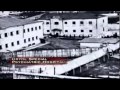
Presidio Modelo prison in Cuba (interior)
Presidio Modelo prison in Cuba (exterior)
From Wikipedia (*spit*) :-
The Panopticon is a type of institutional building designed by English philosopher and social theorist Jeremy Bentham in the late eighteenth century. The concept of the design is to allow an observer to observe (-opticon) all (pan-) inmates of an institution without their being able to tell whether or not they are being watched.
The design consists of a circular structure with an "inspection house" at its centre, from which the managers or staff of the institution are able to watch the inmates, who are stationed around the perimeter. Bentham conceived the basic plan as being equally applicable to hospitals, schools, poorhouses, daycares, and madhouses, but he devoted most of his efforts to developing a design for a Panopticon prison, and it is his prison which is most widely understood by the term.
Bentham himself described the Panopticon as "a new mode of obtaining power of mind over mind, in a quantity hitherto without example."
The panopticon as metaphor
Although the Panopticon prison design did not come to fruition during Bentham's time, it has been seen as an important development. It was invoked by Michel Foucault (in Discipline and Punish) as metaphor for modern "disciplinary" societies and their pervasive inclination to observe and normalise. Foucault proposes that not only prisons but all hierarchical structures like the army, schools, hospitals and factories have evolved through history to resemble Bentham's Panopticon. The notoriety of the design today (although not its lasting influence in architectural realities) stems from Foucault's famous analysis of it.
Building on Foucault, contemporary social critics often assert that technology has allowed for the deployment of panoptic structures invisibly throughout society. Surveillance by closed-circuit television (CCTV) cameras in public spaces is an example of a technology that brings the gaze of a superior into the daily lives of the populace. Furthermore, a number of cities in the United Kingdom, including Middlesbrough, Bristol, Brighton and London have added loudspeakers to a number of their existing CCTV cameras. They can transmit the voice of a camera supervisor to issue audible messages to the public.[14][15] Similarly, critical analyses of internet practice have suggested that the internet allows for a panopticon form of observation.[16] ISPs are able to track users' activities, while user-generated content means that daily social activity may be recorded and broadcast online.[17]
Shoshana Zuboff used the metaphor of the panopticon in her 1988 book In the Age of the Smart Machine: The Future of Work and Power to describe how computer technology makes work more visible. In 1991 Mohammad Kowsar used the metaphor in the title of his book "The Critical Panopticon: Essays in the Theatre and Contemporary Aesthetics" (American University Studies Series Xxvi Theatre Arts). Derrick Jensen and Gerge Draffan's 2004 book Welcome to the Machine: Science, Surveillance, and the Culture of Control demonstrates how our society, by techniques like the use of biometric passports to identity chips in consumer goods, from nanoparticle weapons to body-enhancing and mind-altering drugs for soldiers, is being pushed towards a panopticon-like state.