False Class Consciousness.
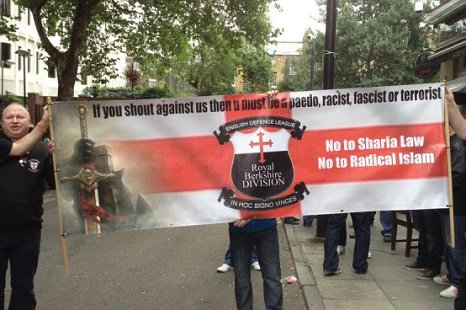
This is bigger than just English nationalism, the conspiracy and new age movement are also manifestations imo.
False consciousness is the Marxist thesis that material and institutional processes in capitalist society are misleading to the proletariat, and to other classes. These processes betray the true relations of forces between those classes, and the real state of affairs regarding the development of pre-socialist society (relative to the secular development of human society in general).
In Marxist theory, false consciousness is essentially a result of ideological control which the proletariat either do not know they are under or which they disregard with a view to their own POUM (probability/possibility of upward mobility).[1] POUM or something like it is required in economics with its presumption of rational agency; otherwise wage laborers would be the conscious supporters of social relations antithetical to their own interests, violating that presumption.[2]
The concept flows from the theory of commodity fetishism — that people experience social relationships as value relations between things, e.g., between the cash in their wage packet and the shirts they want. The cash and the shirt appear to conduct social relations independently of the humans involved, determining who gets what by their inherent values. This leaves the person who earned the cash and the people who made the shirt ignorant of and alienated from their social relationship with each other. So the individual "resolves" the experiences of alienation and oppression through a false conception based on a "natural law" argument that there is a fundamental need to compete with others for commodities.
In Marxist terms, not only is there no such objective need separate from the formulation of the general problem of production and distribution for a given society, moreover, Marx said each against all competition is antithetical to the very concept of society, and therefore sets up a contradiction or historical dynamic which over time is resolved in favor of the class with the greatest ability to act in its own rational self interest. Ruling elites, traditional or otherwise, suffer from false consciousness to the extent that they see the social orders they command as predetermined or inevitable.
Engels
Although Marx frequently denounced ideology in general, there is no evidence that he ever actually used the phrase "false consciousness." It appears to have been used — at least in print — only by Friedrich Engels.[3]
Engels wrote[4]:
“ Ideology is a process accomplished by the so-called thinker. Consciously, it is true, but with a false consciousness. The real motive forces impelling him remain unknown to him; otherwise it simply would not be an ideological process. Hence he imagines false or apparent motives. ...
It is above all this appearance of an independent history of state constitutions, of systems of law, of ideological conceptions in every separate domain, which dazzles most people. If Luther and Calvin “overcome” the official Catholic religion, or Hegel “overcomes” Fichte and Kant, or if the constitutional Montesquieu is indirectly “overcome” by Rousseau with his “Social Contract,” each of these events remains within the sphere of theology, philosophy or political science, represents a stage in the history of these particular spheres of thought and never passes outside the sphere of thought. And since the bourgeois illusion of the eternity and the finality of capitalist production has been added as well, even the victory of the physiocrats and Adam Smith over the mercantilists is accounted as a sheer victory of thought; not as the reflection in thought of changed economic facts but as the finally achieved correct understanding of actual conditions subsisting always and everywhere ... ”
Here Engels expresses semantic baggage associated with the term Ideology, i.e. that it implies a lack of objectivity, which the term had at the time of its introduction from German (due in no small part to a reaction to Hegelianism). This has somewhat substantially been lost over the nearly two centuries since then as Ideology has come to be equated with World View or Philosophy. False consciousness is theoretically linked with the concepts of the dominant ideology and cultural hegemony, and to a lesser extent with cognitive dissonance. The idea of false consciousness has also been used by Marxist feminists and radical feminists in regard to women's studies.
Georg Lukács' History and Class Consciousness (1923)
Class consciousness, as described by Georg Lukács's famous History and Class Consciousness (1923), is opposed to any psychological conception of consciousness, which forms the basis of individual or mass psychology (see Freud or, before him, Gustave Le Bon). According to Lukács, each social class has a determined class consciousness which it can achieve. In effect, as opposed to the liberal conception of consciousness as the basis of individual freedom and of the social contract, Marxist class consciousness is not an origin, but an achievement (i.e. it must be "earned" or won). Hence, it is never assured: the proletariat's class consciousness is the result of a permanent struggle to understand the "concrete totality" of the historical process.[citation needed]
According to Lukács, the proletariat was the first class in history that may achieve true class consciousness, because of its specific position highlighted in the Communist Manifesto as the "living negation" of capitalism. All others classes, including the bourgeoisie, are limited to a "false consciousness" which impedes them from understanding the totality of history: instead of understanding each specific moment as a portion of a supposedly deterministic historical process, they universalize it and believe it is everlasting. Hence, capitalism is not thought as a specific phase of history, but is naturalized and thought of as an eternal solidified part of history. Says Lukács, this "false consciousness", which forms ideology itself, is not a simple error as in classical philosophy, but an illusion which can't be dispelled.[citation needed]
Marx described it in his theory of commodity fetishism, which Lukács completed with his concept of reification: alienation is what follows the worker's estrangement to the world following the new life acquired by the product of his work. The dominant bourgeois ideology thus leads the individual to see the achievement of his labour take a life of its own. Furthermore, specialization is also seen as a characteristic of the ideology of modern rationalism, which creates specific and independent domains (art, politics, science, etc.). Only a global perspective can point out how all these different domains interact, argues Lukács. He also points out how Kant brought to its limit the classical opposition between the abstract form and the concrete, historical content, which is abstractly conceived as irrational and contingent. Thus, with Kant's rational system, history becomes totally contingent and is thus ignored. Only with Hegel's dialectic can a mediation be found between the abstract form and the abstract notion of a concrete content.[5]
Even if the bourgeois loses his individual point of view in an attempt to grasp the reality of the totality of society and of the historical process, he is condemned to a form of false consciousness. As an individual, he will always see the collective result of individual actions as a form of "objective law" to which he must submit himself (liberalism has gone so far as seeing an invisible hand in this collective results, making capitalism the best of all possible worlds). By contrast, the proletariat would be, according to Lukács, the first class in history with the possibility to achieve a true form of class consciousness, granting it knowledge of the totality of the historical process.[citation needed]
The proletariat takes the place of Hegel's Weltgeist ("World Spirit"), which achieves history through Volkgeist ("the spirit of the people"): the idealist conception of an abstract Spirit making history, which ends in the realm of Reason, is replaced by a materialist conception based not on mythical Spirits, but on a concrete "identical subject-object of history": the proletariat. The proletariat is both the "object" of history, created by the capitalist social formation; but it is also the "subject" of history, as it is its labour that shapes the world, and thus, knowledge of itself is also, necessarily, knowledge of the reality and of the totality of the historical process. The proletariat's class consciousness is not immediate; class consciousness musn't be mistaken either with the consciousness of one's future and collective interests, opposed to personal immediate interests.[citation needed]
The possibility of class consciousness is given by the objective process of history, which transforms the proletariat into a commodity, hence objectifying it. Class consciousness is thus not a simple subjective act: "as consciousness here is not the consciousness of an object opposed to itself, but the object's consciousness, the act of being conscious of oneself disrupts the objectivity form of its object" (in "Reification and the Proletariat's Consciousness" §3, III "The proletariat's point of view"). In other words, instead of the bourgeois subject and its corresponding ideological concept of individual free will, the proletariat has been transformed into an object (a commodity) which, when it takes consciousness of itself, transforms the very structure of objectivity, that is of reality.[citation needed]
This specific role of the proletariat is a consequence of its specific position; thus, for the first time, consciousness of itself (class consciousness) is also consciousness of the totality (knowledge of the entire social and historical process). Through dialectical materialism, the proletariat understands that what the individual bourgeois conceived as "laws" akin to the laws of nature, which may be only manipulated, as in Descartes's dream, but not changed, is in fact the result of a social and historical process, which can be controlled. Furthermore, only dialectical materialism links together all specialized domains, which modern rationalism can only think as separate instead of as forming a totality.[citation needed]
Only the proletariat can understand that the so-called "eternal laws of economics" are in fact nothing more than the historical form taken by the social and economical process in a capitalist society. Since these "laws" are the result of the collective actions of individuals, and are thus created by society, Marx and Lukács reasoned that this necessarily meant that they could be changed. Any attempt in transforming the so-called "laws" governing capitalism into universal principles, valid in all times and places, are criticized by Lukács as a form of false consciousness.[citation needed]
As the "expression of the revolutionary process itself", dialectical materialism, which is the only theory with an understanding of the totality of the historical process, is the theory which may help the proletariat in its "struggle for class consciousness". Although Lukács does not contest the Marxist primacy of the economic infrastructure on the ideological superstructure (not to be mistaken with vulgar economic determinism), he considers that there is a place for autonomous struggle for class consciousness.[citation needed]
In order to achieve a unity of theory and praxis, theory must not only tend toward reality in an attempt to change it; reality must also tend towards theory. Otherwise, the historical process leads a life of its own, while theorists make their own little theories, desperately waiting for some kind of possible influence over the historical process. Henceforth, reality itself must tend toward the theory, making it the "expression of the revolutionary process itself". In turn, a theory which has as its goal helping the proletariat achieve class consciousness must first be an "objective theory of class consciousness". However, theory in itself is insufficient, and ultimately relies on the struggle of humankind and of the proletariat for consciousness: the "objective theory of class consciousness is only the theory of its objective possibility".[citation needed]
en.wikipedia.org/wiki/Class_consciousness
www.marxists.org/archive/lukacs/works/history/lukacs3.htm