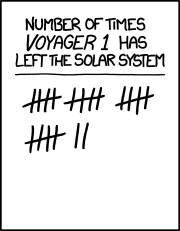
Voyager leaves Our Solar System.......
www.theguardian.com/science/2013/sep/12/...-leaves-solar-system
Voyager 1 leaves solar system
Nasa scientists say they believe the spacecraft has now reached interstellar space, beyond the influence of the sun
After 36 years and a journey that took the spacecraft 12 billion miles beyond the sun, Voyager 1 has left the solar system, the first human jaunt into interstellar space, U.S. scientists said.
The probe crossed into a region of cold, dark space outside the heliosphere, a bubble of charged particles at the boundary of the solar system, on Aug. 25, 2012, according to a report in the journal Science by researchers from the National Aeronautics and Space Administration and the University of Iowa.
Voyager 1
Mission type Planetary exploration
Operator NASA / JPL
COSPAR ID 1977-084A[1]
SATCAT № 10321[2]
Website voyager.jpl.nasa.gov
Mission duration 36 years and 8 days elapsed
Planetary mission: 3 years, 3 months, 9 days
Interstellar mission: 32 years, 8 months, and 30 days elapsed (continuing)
Spacecraft properties
Manufacturer Jet Propulsion Laboratory
Launch mass 721.9 kilograms (1,592 lb)
Power 420 watts
Start of mission
Launch date September 5, 1977, 12:56:00 UTC
Rocket Titan IIIE
Launch site Cape Canaveral LC-41
Flyby of Jupiter
Closest approach March 5, 1979
Distance 349,000 kilometres (217,000 mi)
Flyby of Saturn
Closest approach November 12, 1980
Distance 124,000 kilometres (77,000 mi)
The Voyager 2 spacecraft is a 722 kg (1,590 lb) space probe launched by NASA on August 20, 1977 to study the outer Solar System and eventually interstellar space. It was actually launched before Voyager 1, but Voyager 1 moved faster and eventually passed it. It has been operating for 36 years and 23 days as of 12 September 2013; the spacecraft still receives and transmits data via the Deep Space Network.[4] At a distance of 101.75 AU (1.522×10¹⁰ km) as of 12 September 2013 from earth,[5] it is one of the most distant manmade objects (along with Voyager 1, Pioneer 10 and Pioneer 11). {note: for current distance see.[5]} Voyager 2 is part of the Voyager program with its identical sister craft Voyager 1, and is in extended mission, tasked with locating and studying the boundaries of the Solar System, including the Kuiper belt, the heliosphere and interstellar space. The primary mission ended December 31, 1989 after encountering the Jovian system in 1979, Saturnian system in 1980, Uranian system in 1986, and the Neptunian system in 1989. It is still the only spacecraft to have visited the two outer giant planets Uranus and Neptune. The probe is now moving at a velocity of 15.428 km/second
Each Voyager space probe carries a gold-plated audio-visual disc in the event that either spacecraft is ever found by intelligent life-forms from other planetary systems.[9] The discs carry photos of the Earth and its lifeforms, a range of scientific information, spoken greetings from the people (e.g. the Secretary-General of the United Nations and the President of the United States, and the children of the Planet Earth) and a medley, "Sounds of Earth", that includes the sounds of whales, a baby crying, waves breaking on a shore, and a variety of music.
Both Voyagers are carrying a gold record
goldenrecord.org/
The contents of the Voyager Golden Record is a collection of 116 images ... Voyager and can understand these recorded contents, here is our message: .... We strive to live in peace with the peoples of the whole world, of the whole cosmos.