Mormon's and Freemasons.
In the Spring of 2002 the LDS Church completed its reconstruction of the Nauvoo Temple in Illinois. It was originally built in the 1840's but was destroyed after the Mormons abandoned the town. Due to the publicity and photos regarding this new temple many people have asked about the symbols on the building.
To understand the symbols one must first know something of Joseph Smith's involvement with Freemasonry. Joseph's brother, Hyrum, had been a Mason since the 1820's. Many other members of the LDS church, like Brigham Young, were Masons before they joined Mormonism. LDS historian Reed Durham observed:
"By 1840, John Cook Bennett, a former active leader in Masonry had arrived in Commerce [Nauvoo] and rapidly exerted his persuasive leadership in all facets of the Church, including Mormon Masonry. ... Joseph and Sidney [Rigdon] were inducted into formal Masonry...on the same day..." ("Is There No Help for the Widow's Son?" by Dr. Reed C. Durham, Jr., as printed in Joseph Smith and Masonry: No Help for the Widow's Son, Martin Pub. Co., Nauvoo, Ill., 1980, p. 17.)
Reed Durham further commented:
"I have attempted thus far to demonstrate that Masonic influences upon Joseph in the early Church history, preceding his formal membership in Masonry, were significant....In fact, I believe that there are few significant developments in the Church, that occurred after March 15, 1842, which did not have some Masonic interdependence." (Joseph Smith and Masonry: No Help for the Widow's Son, p.17)
The History of the Church records Smith's entrance into the Masonic lodge in 1842:
"Tuesday, 15.—I officiated as grand chaplain at the installation of the Nauvoo Lodge of Free Masons, at the Grove near the Temple. Grand Master Jonas, of Columbus, being present, a large number of people assembled on the occasion. The day was exceedingly fine; all things were done in order, and universal satisfaction was manifested. In the evening I received the first degree in Free Masonry in the Nauvoo Lodge, assembled in my general business office." (History of the Church, by Joseph Smith, Deseret Book, 1978, Vol.4, Ch.32, p.550-1)
The next day Smith recorded:
"Wednesday, March 16.—I was with the Masonic Lodge and rose to the sublime degree." (History of the Church, Vol.4, Ch.32, p.552)
The Mormon involvement in Freemasonry reached its heights during the early 1840's in Nauvoo. In the Encyclopedia of Mormonism we read:
"The introduction of Freemasonry in NAUVOO had both political and religious implications....Eventually nearly 1,500 LDS men became associated with Illinois Freemasonry, including many members of the Church's governing priesthood bodies—this at a time when the total number of non-LDS Masons in Illinois lodges barely reached 150." (Encyclopedia of Mormonism, vol.2, p.527)
The Salt Lake Tribune (May 4, 2002, p.C3) printed a picture of the original Nauvoo temple weather vane, which shows the Masonic symbol of the compass and square above the angel. Reporter Peggy Stack wrote:
"Every detail of the historic Nauvoo Temple was reconstructed [in the new Nauvoo temple] meticulously with one exception: the flying angel weather vane that graced the top of the 19th century Mormon edifice.
"In its place is the gold-leafed Angel Moroni, first used on the Salt Lake Temple,...
"Some speculate that the horizontal angel, with its compass and square, may be too closely associated with Masonic rituals for modern Mormons." (Salt Lake Tribune, May 4, 2002, p.C3)
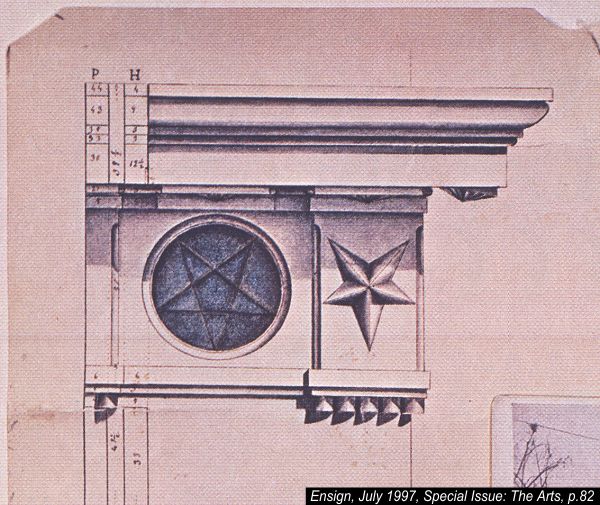
"It is also obvious that the Nauvoo Temple architecture was in part, at least Masonically influenced. Indeed, it appears that there was an intentional attempt to utilize Masonic symbols and motifs. The sun stones, and the moon and star stones, were examples. An additional example was the angel used on the weather vane on the top of the Temple. [Above the angel] is a beautiful compass and square, in the typical Masonic fashion." (Joseph Smith and Masonry: No Help for the Widow's Son, p.18)
Reed Durham observed:
"There is absolutely no question in my mind that the Mormon ceremony which came to be known as the Endowment, introduced by Joseph Smith to Mormon Masons initially, just a little over one month after he became a Mason, had an immediate inspiration from Masonry....
Also you'll find these symbols on the church.
www.utlm.org/onlineresources/masonicsymbolsandtheldstemple.htm




 , silly wankers!

 poor lil mis-informed chappies, i reckon they are. I just hope they dont become postal workers