This will be in two parts and hopefully provide some basic historical insight to the development of Money, Commerce and Economics.
1. Trade
From the fertile Nile Vally civilization flowed grain, linen, papyrus and oils, into Asia-Minor by land and into the Black Sea, English Channel and Baltic regions by river. Trade routes also ran overland to the Tigris and Euphrates, onto the Persian Gulf and through the Hindukushite mountains into India where diamonds were mined, the far east and China famous for it's silk.
The Monsoon winds carried trade directly from the mouth of the Red Sea towards India and back, ensuring there were trade links and cultural diffusion between the two continents for as long as humans there had knowledge of sailing.
In the earliest periods of man trade between people and places in the same locality was far more prolific than that carried out with different countries, still there is evidence of a considerable amount of exchange even then, between widely scattered people and places.
In Europe the Rhine, Danube and Rhone Saone were important highways of commerce, while the Alpine pass of St Gotthard and others served as links between North European and Meditteranean trading markets.
The Meditteranean specialized in producing particular commodities and was a vital trading outpost for Asian commodities, the Northern regions, Germany and France produced wine, furs came from Scandinavia and Russia* along with fish, timber and metals like copper and iron, Sweden still maintains a reputation for high grade steel and irons it already had in the 14th century. Salt for preservation of fish and food for trading was obtained by evaporation of sea water on the Bay of Biscay and by working deposits in Cheshire, Salzburg and other places in Europe.
This maritime trade was dominated in these regions by The Hanseatic League**, which held waterways and communities along the Rhine, to the Baltic and North Sea, they traded with Northern Europe and the East via Kiev and Astrakhon.
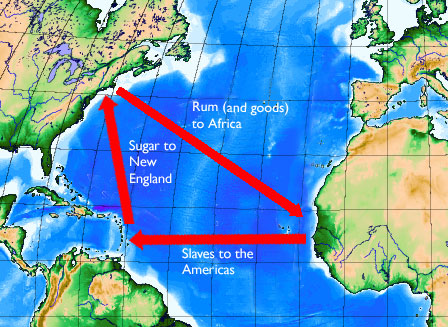
Adam Smith the 18th Century Economics Theorist wrote that the discovery of America and the Cape Route to India were the most important in the history of humankind. The most valuable of these newly discovered regions were the Sugar Islands of the West Indies and the Tobacco lands of Northern America, these areas produced goods for the European markets by means of Slave labour imported from Africa as part of the infamous Triangular Trade***.
The Industrial Revolution allowed Britain to mass produce manufactured goods and export large quantities of Wool and Cotton textiles, throughout Europe, supplying shipping, insurance and banking services for foreign merchants enabled Britain to increase food and raw material imports and Industrialize the peasantry.
This process of specialization; moving away from Agricultural means of existence to the production of a narrow range of products, subsequent dependence on commerce, and imports from every corner corner of the globe for basic needs, has been a defining and ongoing characteristic of British society, speeding up dramatically since the advent of the Steam Train in the 19th century, leading to basic staples of British production, meat, apples, veg requiring to be imported while farms here shut down production.
*https://en.wikipedia.org/wiki/Novgorod_Republic
a large medieval Russian state which stretched from the Baltic Sea to the Ural Mountains between the 12th and 15th centuries, centred on the city of Novgorod.
**https://en.wikipedia.org/wiki/Hanseatic_League
Exploratory trading adventures, raids and piracy had happened earlier throughout the Baltic (see Vikings)—the sailors of Gotland sailed up rivers as far away as Novgorod, for example—but the scale of international trade economy in the Baltic area remained insignificant before the growth of the Hanseatic League.
***https://en.wikipedia.org/wiki/Triangular_trade#Atlantic_triangular_slave_trade
Triangular trade, or triangle trade, is a historical term indicating (trade) among three ports or regions. Triangular trade usually evolves when a region has export commodities that are not required in the region from which its major imports come. Triangular trade thus provides a method for rectifying trade imbalances between the above regions.